
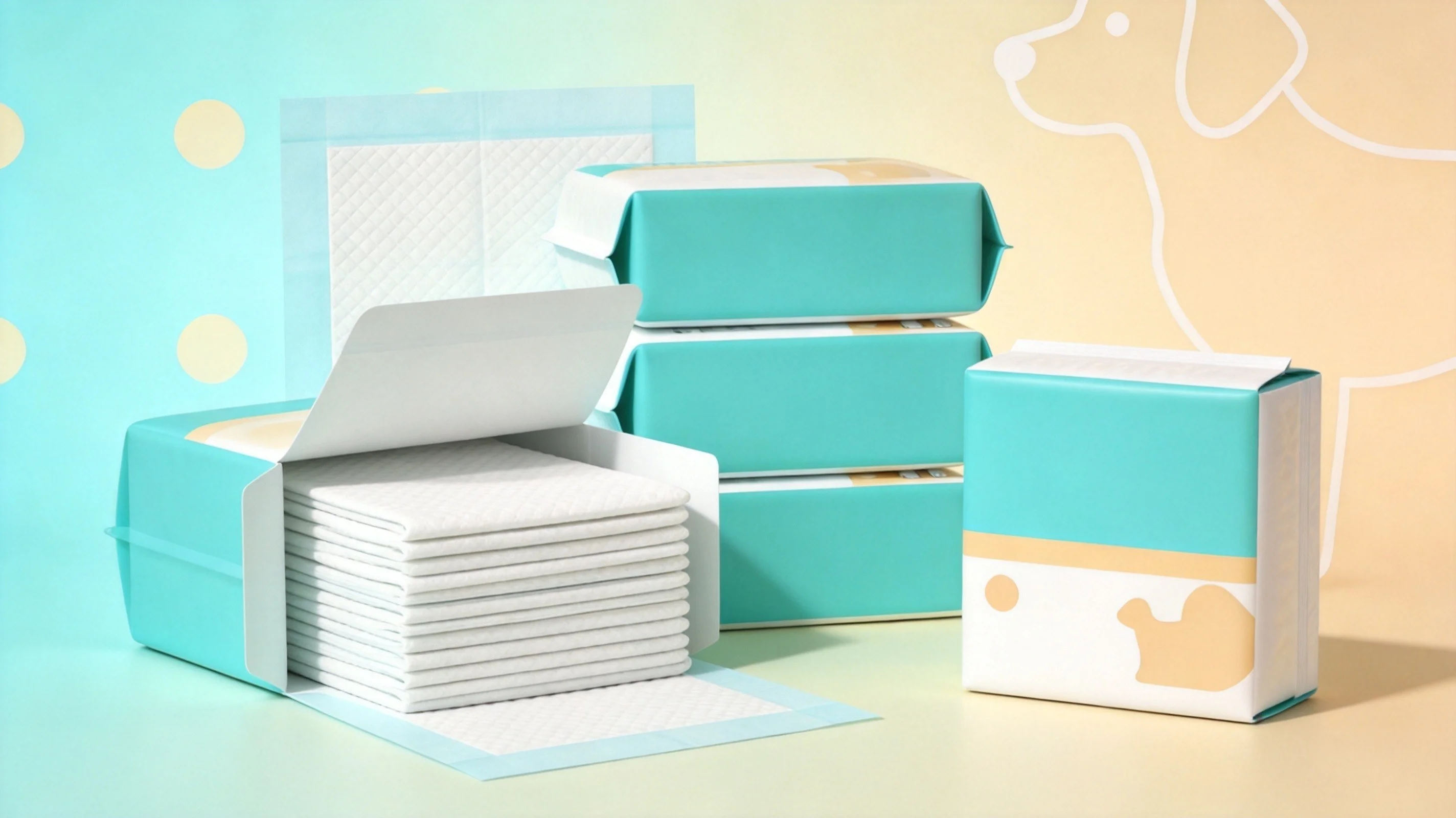
Pet pads are a volume business with a hard cost ceiling. The fiber has to deliver defined capacity at a price the shelf can carry, and it has to do so consistently across millions of units.
Application Overview
A pet pad is a simpler structure than a diaper: a nonwoven topsheet, a fluff core with or without SAP, and a waterproof backsheet with sealed edges. There is no ADL, no elastic, and no complex shaping.
That simplicity is what makes fiber choice so visible in the cost. In a diaper, fiber is one of many cost lines. In a pet pad, it is the dominant material cost after the backsheet.
So the specification question is narrow and concrete: what is the lowest-cost fiber configuration that still meets the capacity and leakage target for this product tier?
Product Formats We Support
Training Pads
Cost-optimised cores for puppy training and household use
Professional Grooming Pads
Higher capacity for repeated use in salons and clinics
Veterinary & Clinic Pads
Absorbent pads for examination tables and recovery
Travel & Disposable Pads
Compact formats with defined capacity per sheet
Multi-Layer Pads
Composite structures with a distribution layer
Oversized Pads
Wide-format products requiring uniform formation
Typical Requirements and Our Approach
| Requirement | Typical Target | How We Meet It |
|---|---|---|
| Capacity per unit area | Product-tier specific | Blend ratio tuned against the capacity floor |
| Unit cost | Dominant constraint | CMP and hardwood blends replace softwood where performance allows |
| Leakage control | No edge wicking failure | Uniform formation and controlled fines to keep edges sound |
| Surface dryness | Reasonable for repeated use | Adequate bulk to avoid immediate rewet |
| Formation uniformity | Consistent across wide formats | Controlled fiber length distribution on wide forming sections |
| Run stability | High throughput, minimal downtime | Low dust and stable sheet opening |
Pet pad specifications are almost always cost-driven. Send us your capacity target and cost ceiling and we will propose the cheapest configuration that meets both.
Detailed Description
Where the cost actually sits
After the backsheet, fluff pulp is the largest material cost in a pet pad. That makes blend ratio the primary cost lever — and the primary risk. A blend that takes out 15% of the fiber cost but causes edge wicking failures will cost more in rejects than it saves.
The safe pattern is to push the blend ratio down in stages, testing leakage at each step rather than jumping to the target ratio in one trial.
Edge wicking is the usual failure mode
Pads fail at the edges. Liquid travels along the sealed border and escapes before the core can absorb it. Two fiber properties drive this: fines content and formation uniformity. High fines create dense bands that wick liquid outward; poor uniformity creates thin spots that saturate locally.
Test edge leakage on the widest format you produce. A specification that passes on a narrow pad can fail on an oversized one.
When to use SAP
Light training pads often run without SAP, relying on fiber capacity alone. Professional and veterinary pads usually add SAP because the required capacity per unit area is higher. Once SAP is present, fiber bulk matters again — it keeps the particles distributed rather than settling to one end of the pad during transport.


